Why Businesses Hire a Power BI Consultant Instead of Building In-House
Many SMBs eventually ask whether they should hire a Power BI consultant or build internal BI capability. The answer is not universal. The right choice depends on urgency, complexity, internal capacity, governance needs, and how much reporting demand will continue after the first project.
When it makes sense to hire a Power BI consultant
Businesses often hire a Power BI consultant when they need speed, specialized expertise, or a defined outcome. The need may be a new executive dashboard, a Power BI implementation, a slow-report fix, a governance plan, or a reporting automation project that internal staff cannot take on without delaying other work.
Consulting is especially useful when the business problem crosses several disciplines. A dashboard may require data-source review, data modeling, DAX measures, security, workspace structure, refresh design, and user training. An internal analyst may understand the business well but not have time or experience to design the full architecture.
Common reasons SMBs hire outside help include:
- A leadership team needs reliable reporting quickly.
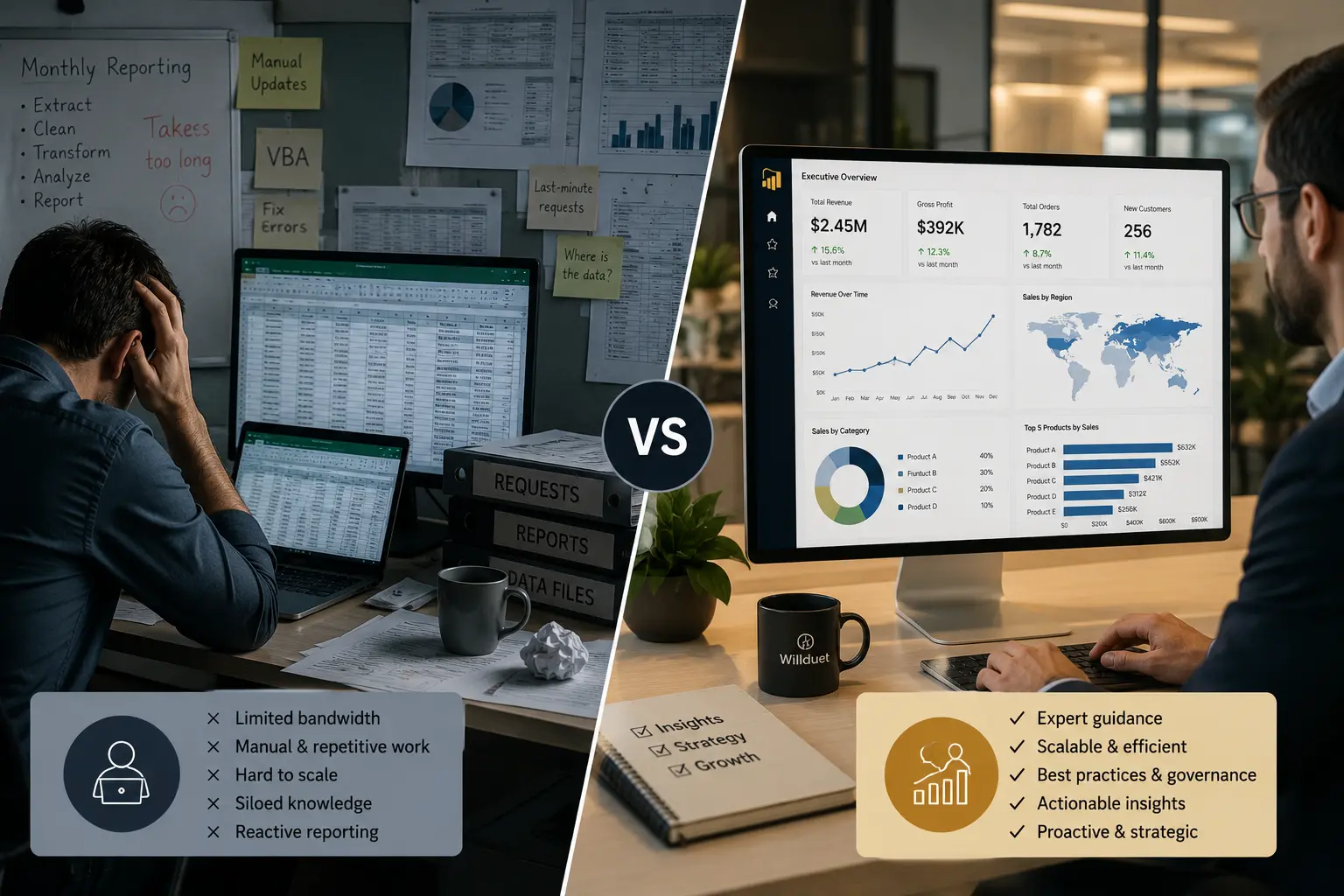
- Current Excel reporting is too manual or fragile.
- Existing Power BI reports are slow, inconsistent, or hard to maintain.
- The company needs implementation guidance before building too much on a weak foundation.
- Security, governance, or deployment standards are unclear.
- Internal staff need knowledge transfer from someone with deeper Power BI experience.
If the question is what a consultant actually does day to day, start with what a Power BI consultant does. If you are evaluating scope and deliverables, read our guide to Power BI consulting services.
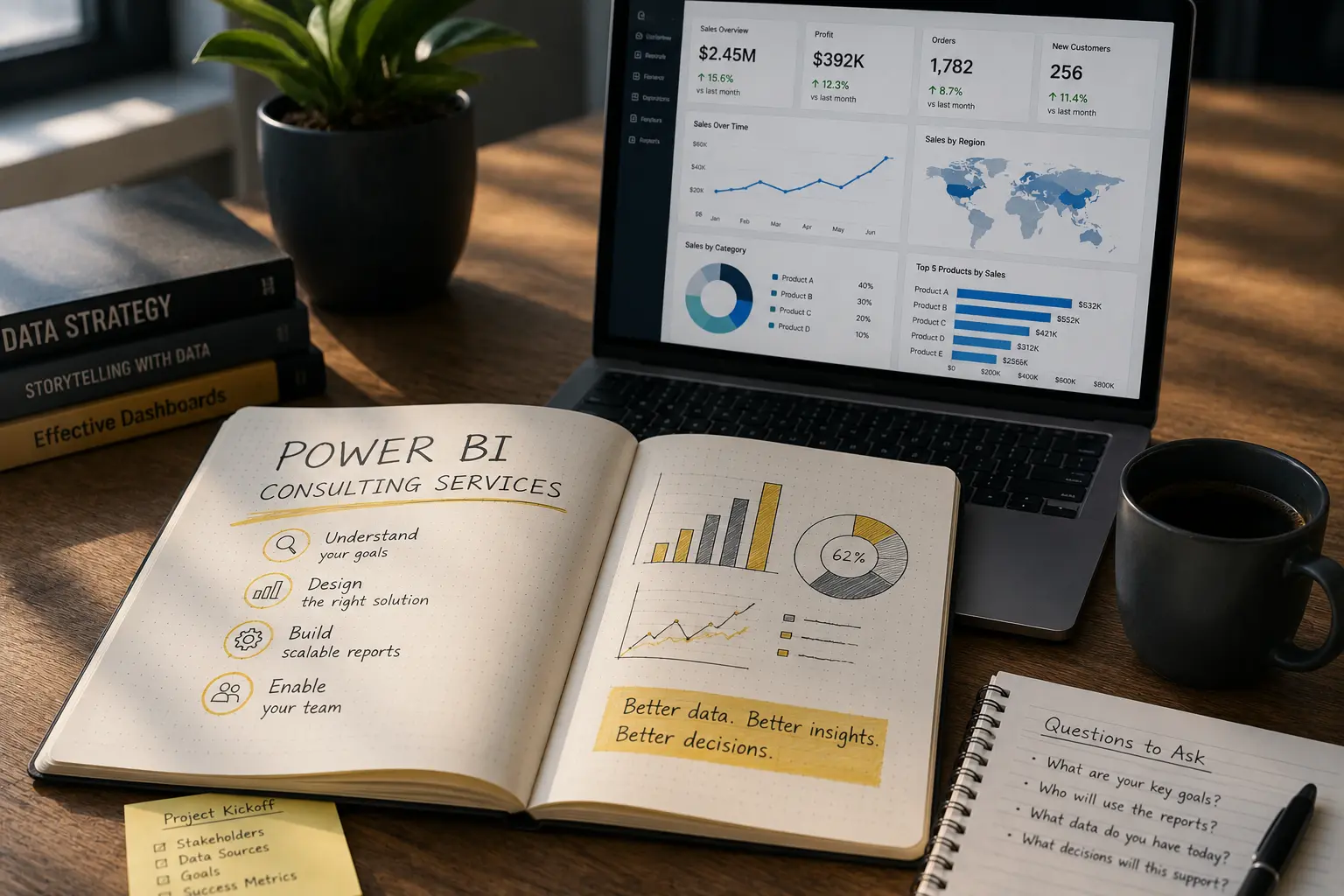
Businesses that want outside support can also review Willduet's Power BI consulting services to understand the types of reporting and implementation work a consulting engagement can cover.
When an in-house BI team is the better choice
Internal teams have real advantages. They understand company context, internal politics, source systems, recurring decisions, and stakeholder history. If the business has continuous reporting demand, frequent changes, and enough volume to justify dedicated staff, an in-house BI team may be the stronger long-term model.
In-house capability is especially valuable when reporting is part of daily operations. A company with many departments, ongoing dashboard requests, and complex business rules may need internal ownership for prioritization, support, and relationship management.
Building in-house is often the better choice when:
- Reporting demand is ongoing rather than project-based.
- Business knowledge is deep and changes frequently.
- The company needs full-time support for many departments.
- Data governance requires close coordination across IT, finance, and operations.
- The business can recruit, manage, and retain BI talent.
- Leadership wants long-term internal ownership of the BI roadmap.
The tradeoff is ramp-up time. Recruiting a qualified business intelligence consultant or BI developer can take time, and a new hire still needs onboarding. If the business needs reliable dashboards in the short term, a consultant may help bridge the gap.
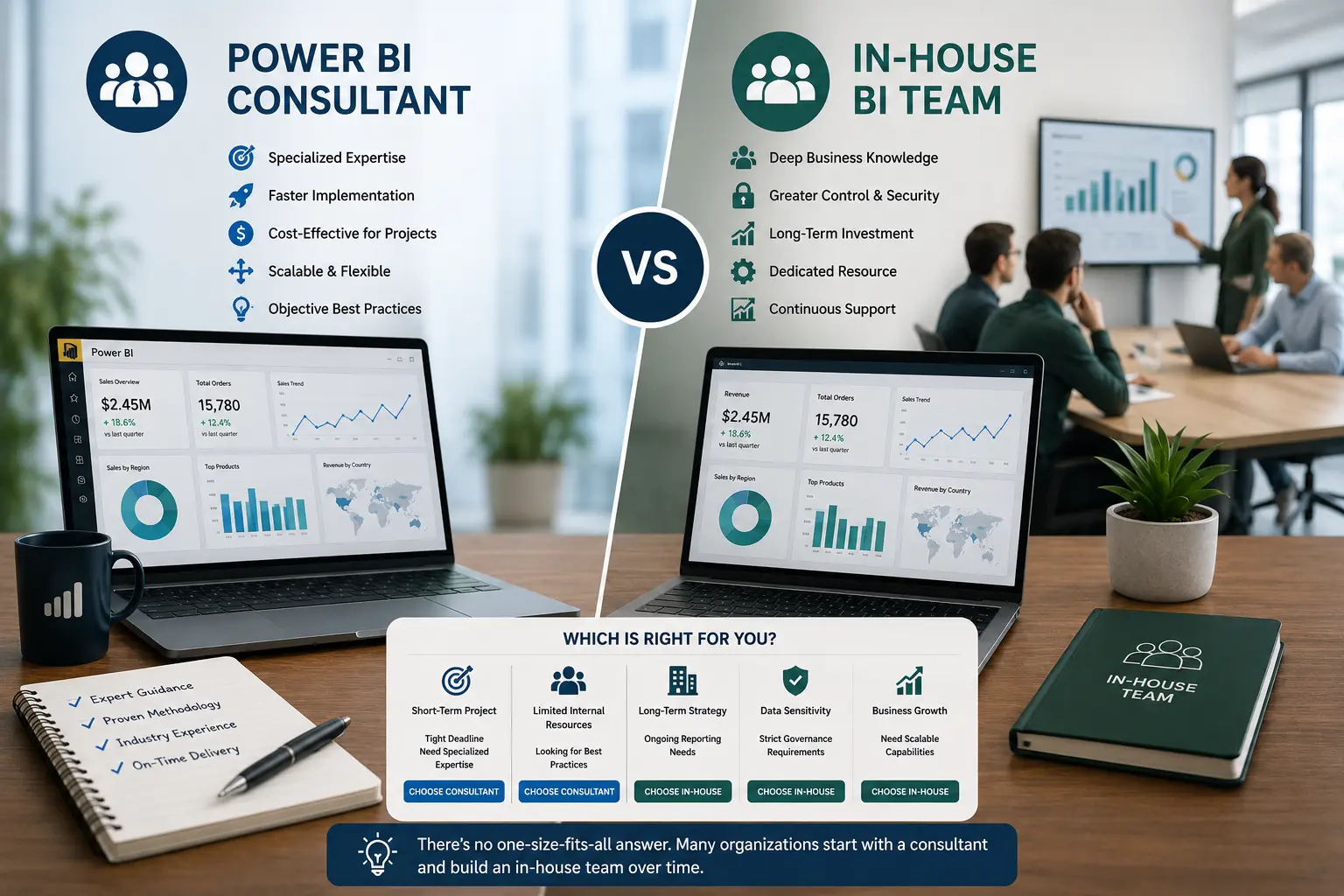
Hire power bi consultant vs build in-house: decision comparison
Cost structure without inventing exact prices
Cost should be evaluated by workload, risk, and long-term ownership rather than by a single hourly comparison. A consultant may cost more per hour than an employee, but a focused engagement can be more practical when the need is temporary or specialized. An employee may be more economical when reporting demand is constant and broad.
Factors that affect consulting cost include data-source complexity, number of dashboards, data quality, security requirements, refresh frequency, model complexity, and the amount of training or support needed. Similar factors affect internal hiring because they determine the level of experience required.
For implementation planning, see our article on Power BI implementation cost. It explains cost drivers without inventing generic pricing.
Security, governance, and vendor dependency risks
Some leaders hesitate to use consultants because they worry about data access and dependency. Those concerns are legitimate. A consultant should work within approved access controls, use appropriate environments, document what they build, and avoid becoming the only person who understands the solution.
A good engagement reduces dependency through documentation, reusable model patterns, clear workspace ownership, training, and a defined support transition. Internal staff should understand where the data comes from, how KPIs are calculated, how refresh works, and how access is managed.
Governance is also not only an internal-team issue. Consultants can help establish standards, but the business must own policy decisions. Our guides to Power BI governance and Power BI security best practices explain the controls that matter as usage grows.
Hybrid models often work best for SMBs
Many SMBs do not need to choose a pure consulting model or a fully internal team. A hybrid approach can provide outside expertise while building internal ownership. The consultant may design the foundation, solve complex issues, train internal staff, and help launch the first dashboards. Internal staff then handle recurring reporting, stakeholder questions, and small changes.
A hybrid model is useful when the business has strong internal knowledge but limited Power BI architecture experience. It is also useful when the company plans to hire later but needs reporting improvements now.
A practical decision framework
- Use a consultant when the need is urgent, specialized, or project-based.
- Build in-house when reporting demand is continuous and broad.
- Use a hybrid model when internal staff know the business but need expert setup, standards, or training.
- Prioritize documentation and handoff when using any external provider.
- Reassess the model as Power BI adoption grows.
If your company is moving from spreadsheet reporting to Power BI, our Power BI vs Excel guide may help clarify when the reporting process is ready for a more scalable approach.
Need help deciding the right BI delivery model?
Willduet helps SMBs evaluate Power BI consulting, dashboard development, implementation support, optimization, and practical handoff plans.
Conclusion: hire power bi consultant
The decision to hire power bi consultant support or build an in-house BI team should be based on business need, timing, complexity, cost structure, and long-term ownership. Consultants can provide speed and specialized expertise. Internal teams provide continuity and deep business knowledge. For many SMBs, the best answer is a hybrid model that uses outside help to create a strong foundation while building internal capability over time.
Frequently asked questions
When should a business hire a Power BI consultant?
Hiring a consultant makes sense for focused projects, urgent reporting needs, specialized architecture or optimization work, governance setup, and situations where internal capacity is limited.
When is an in-house BI team better?
An in-house team is usually better when the company has ongoing reporting demand, many internal stakeholders, frequent changes, and enough workload to justify dedicated staff.
Can a business use both a consultant and internal staff?
Yes. A hybrid model is often practical: a consultant handles architecture, implementation, optimization, or training while internal staff own day-to-day reporting and business knowledge.
Is hiring a consultant always cheaper than hiring employees?
Not always. Consulting can be cost-effective for defined needs or specialized work, while in-house hiring may make sense when reporting demand is continuous and long term.
How do you reduce dependency on a consultant?
Require documentation, model handoff, training, clear ownership, reusable standards, and a support transition plan before the engagement ends.
What should SMBs compare before deciding?
Compare urgency, internal skills, project complexity, ongoing workload, data security, governance needs, budget structure, and long-term ownership.