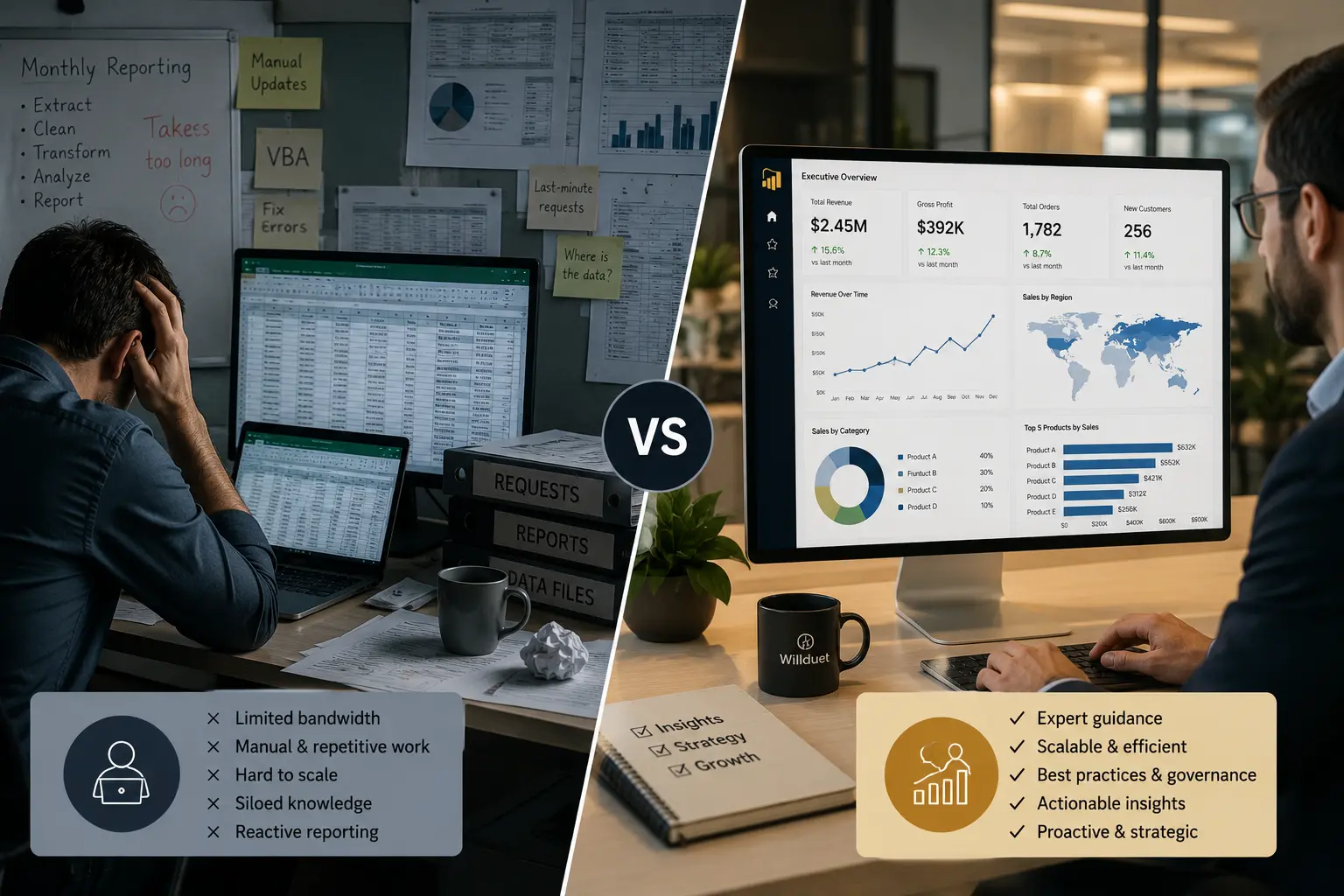
Power BI Consultant vs In-House BI Team: Which Is Right for Your Business?
A Power BI consultant can bring specialized expertise quickly. An in-house BI team can provide long-term ownership. The right choice depends on urgency, complexity, budget, governance, and the reporting role inside your business.
Power BI consultant vs in-house BI team: the real difference
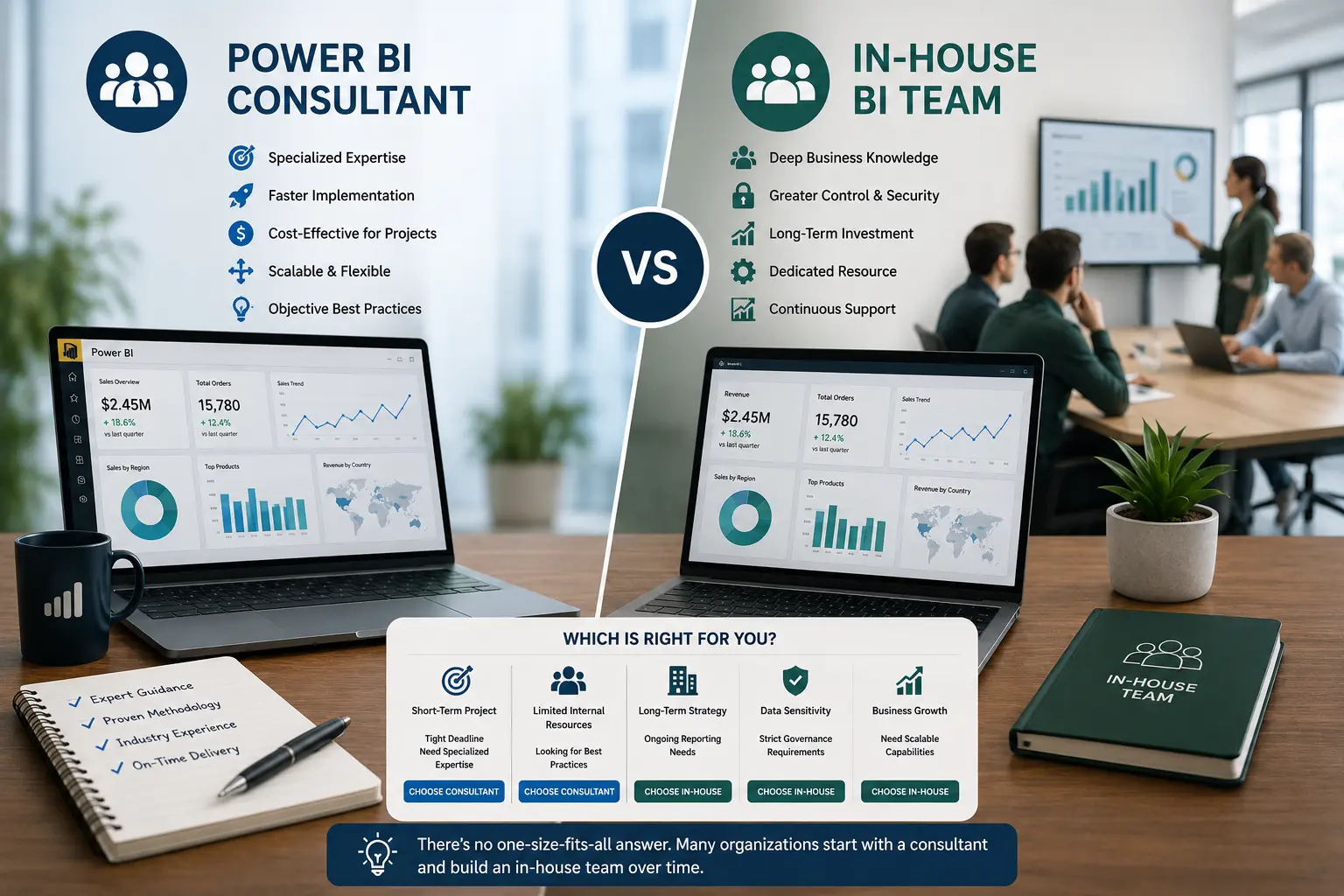
A Power BI consultant is usually brought in for focused expertise: implementation, dashboard development, optimization, governance, security, data modeling, or training. An in-house BI team owns reporting over time, works closely with departments, and supports ongoing analytics needs.
The decision is not always either-or. Many businesses need both. A consultant can design the foundation, solve difficult problems, or accelerate delivery. The internal team can own the roadmap, business relationships, and day-to-day support.
When a Power BI consultant makes sense
You need expertise quickly
If leadership needs dashboards soon and the internal team is overloaded, a consultant can reduce delay. This is common during executive reporting projects, finance reporting automation, or urgent performance fixes.
The project requires specialized skills
Power BI implementation may require data modeling, DAX, SQL Server tuning, Power Query, security, deployment, and governance. A general analyst may not have all of those skills.
Your reports are slow or unreliable
A Power BI consultant can diagnose whether the issue comes from model size, relationships, DAX, visuals, DirectQuery, refresh design, or source system performance.
You need a governance strategy
Governance becomes important when reports multiply, KPIs conflict, or security rules are unclear. A consultant can help design the operating model before the environment becomes difficult to manage.
When an in-house BI team makes sense
Reporting is continuous and strategic
If every department depends on reporting, an internal BI team can provide ongoing ownership. They understand company systems, stakeholders, and business priorities.
You need daily business partnership
Internal BI teams can sit close to finance, operations, sales, and leadership. That helps with recurring analysis, ad hoc requests, and process knowledge.
You have enough work to justify dedicated roles
Hiring makes sense when there is enough demand for dashboard development, data engineering, governance, training, support, and analytics roadmap management.
Power BI consultant vs in-house BI team comparison
A hybrid model often works best
Many companies use a hybrid model. A Power BI consultant helps with architecture, implementation services, dashboard development, optimization, or governance. The internal team owns business relationships, prioritization, and ongoing support.
This model works well when the business wants to move quickly without creating long-term dependency. It also helps internal teams learn stronger patterns while still delivering projects.
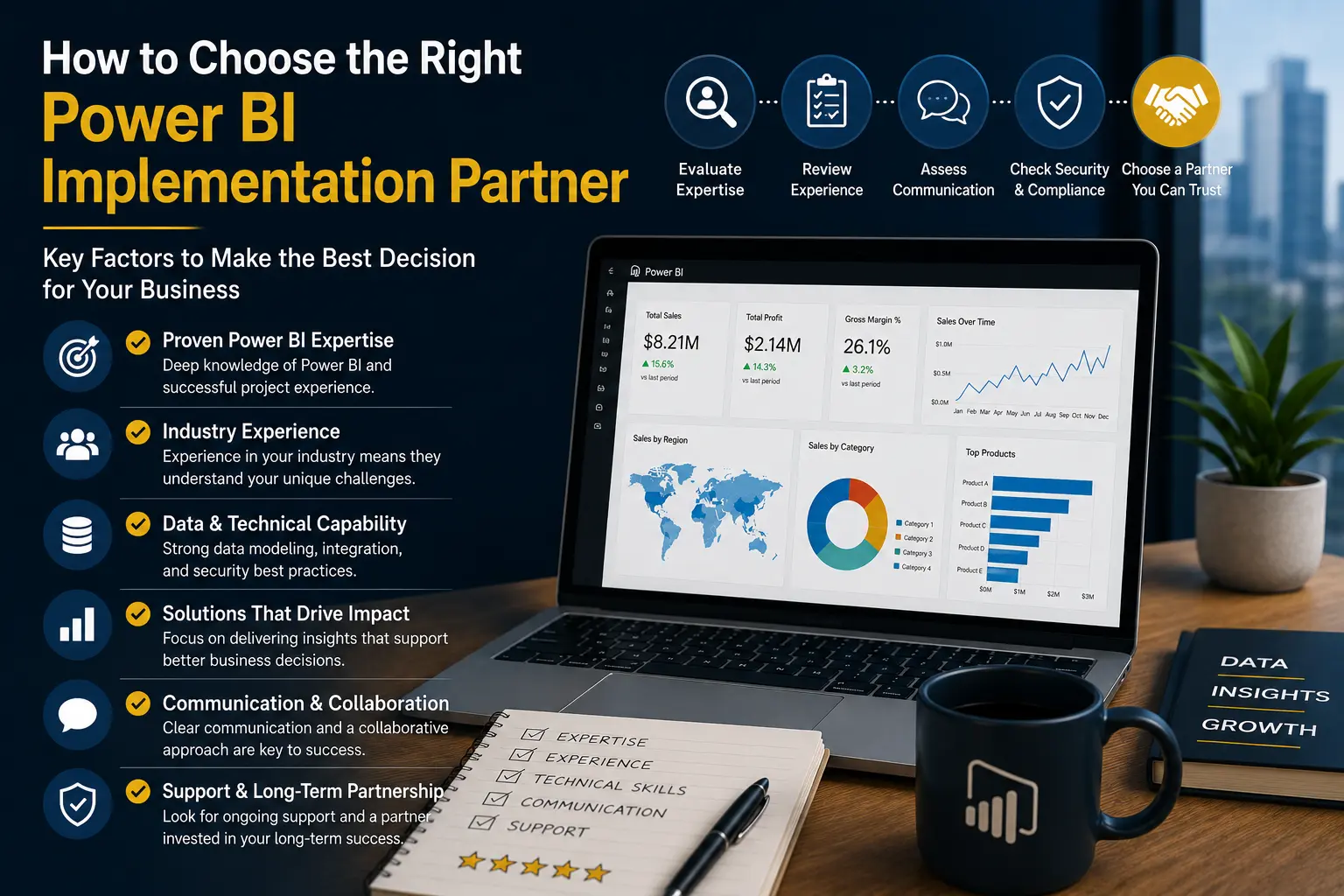
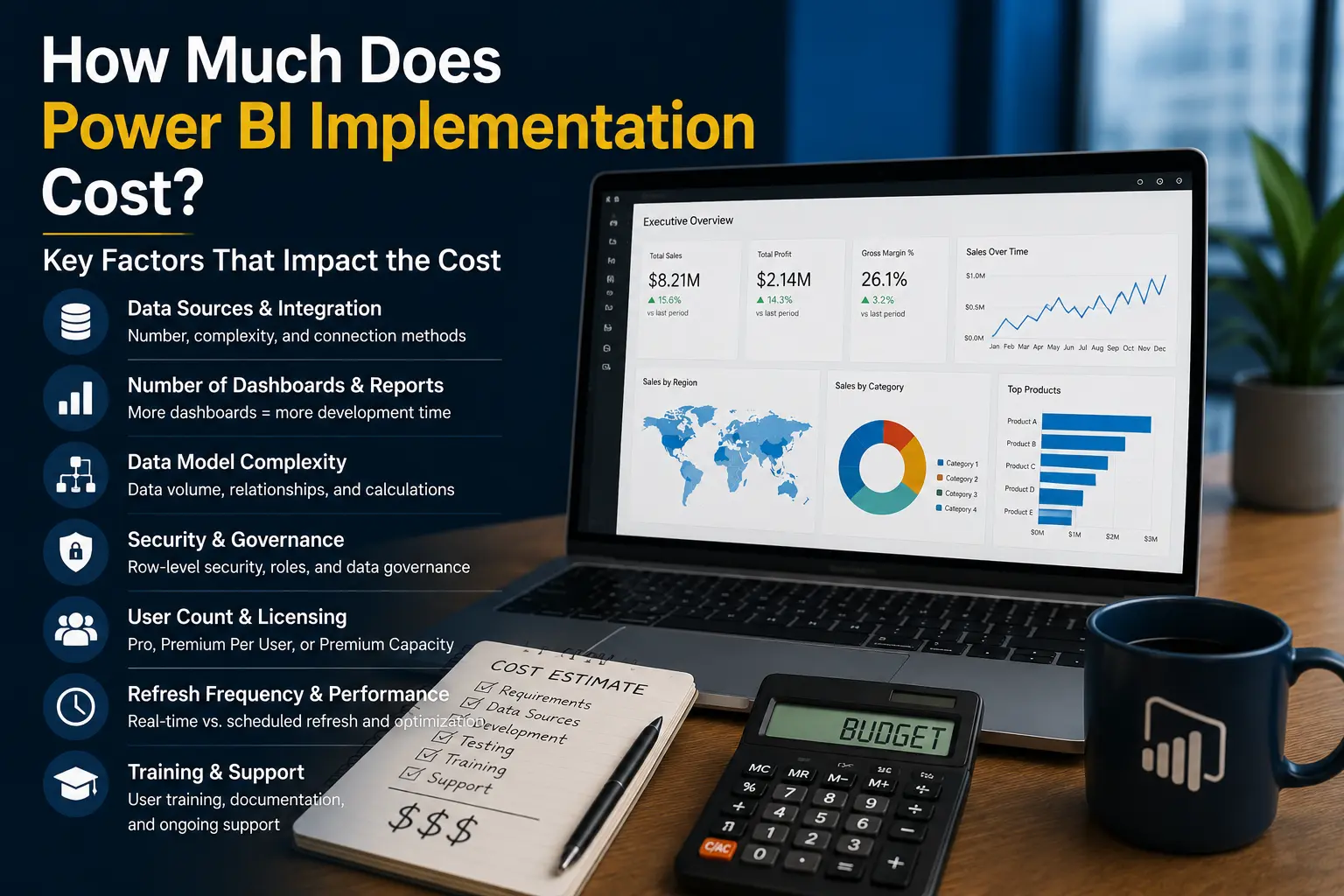
For related planning, see how to choose a Power BI implementation partner, Power BI implementation cost, and Power BI governance.
How to decide what to keep in-house
The best work to keep in-house is work that depends heavily on company context and repeats over time. This includes stakeholder management, KPI ownership, department prioritization, and ongoing report support. Internal teams understand the politics, processes, and business language of the organization.
The best work to use a consultant for is work that requires specialized depth or temporary acceleration. This includes Power BI implementation services, semantic model design, DAX optimization, SQL Server performance tuning, row-level security design, governance strategy, and dashboard development for high-visibility reporting.
A practical split might look like this: the consultant designs the model, builds the first executive dashboard, documents the approach, and trains the internal team. The in-house team then owns future enhancements, user requests, and business prioritization. This gives the business expert help without creating permanent dependency.
Consider the cost of delay
Companies sometimes compare consulting cost only against employee cost. That misses the cost of delay. If leadership needs reliable reporting now, waiting months to hire and onboard may have a business cost. If the internal team is already overloaded, adding Power BI implementation on top of existing responsibilities may create shortcuts that cost more later.
Consider the cost of poor architecture
A dashboard can be built quickly and still be expensive if it cannot scale. Poor data models, unclear security, duplicated measures, and slow reports create rework. A Power BI consultant can help set the architecture so an internal team has a better foundation to own.
Questions to ask before choosing a Power BI consultant or hiring internally
Before deciding, clarify the business need. Is this a one-time implementation, a recurring analytics program, or a backlog of reporting problems? Is the most urgent issue dashboard development, Power BI optimization, governance, security, data engineering, or stakeholder management? Different needs point to different staffing models.
If the issue is specialized and urgent, a Power BI consultant may be the better first move. If the issue is continuous demand across every department, an in-house BI team may be necessary. If both are true, start with a hybrid model.
- Do we need delivery speed or long-term ownership most?
- Do we already have strong data modeling and DAX skills internally?
- Are our source systems and SQL layer ready for reporting?
- Do we need governance and security design before scaling?
- Can our internal team support reports after launch?
- Would outside expertise help train or unblock the internal team?
The best decision is usually the one that reduces risk while building internal capability. A consultant can help set the direction, but the business still needs ownership. An internal team can own the roadmap, but it may still benefit from specialized support at critical moments.
How to make consulting support successful
Consulting works best when the business is prepared to participate. A Power BI consultant still needs access to source systems, example reports, subject matter experts, security requirements, and timely feedback. If stakeholders are unavailable, the project slows down no matter how strong the consultant is.
For a deeper comparison of external expertise, internal ownership, and hybrid models, see why businesses hire a Power BI consultant instead of building fully in-house.
Define the outcome before work begins. The outcome might be an executive dashboard, a governed semantic model, a performance-optimized report, a security design, or a roadmap for Power BI governance. Clear outcomes make the engagement easier to manage.
Also define knowledge transfer. If the company has an in-house BI team, the consultant should explain design decisions, document assumptions, and leave the team with a maintainable solution. The goal is not only delivery; it is better internal capability after the project.
For business leaders, the main question is whether outside help will reduce risk, accelerate value, or improve quality. If the answer is yes, a Power BI consultant can be a practical investment even when the company also plans to build internal BI capacity.
How to avoid dependency on either option
A company can become too dependent on a consultant if no internal owner learns the solution. It can also become too dependent on an internal team if knowledge sits with one employee and no documentation exists. The risk is not the staffing model by itself; the risk is lack of knowledge transfer and process.
Avoid dependency by documenting semantic models, data sources, KPI definitions, refresh schedules, security roles, and deployment steps. Make sure at least one internal owner understands how the solution works. If consultants are involved, require handoff sessions and practical documentation.
The strongest model combines expertise with ownership. Consultants can accelerate and improve the work, while the business keeps control of priorities, definitions, and long-term reporting direction.
This balance matters because Power BI is both technical and operational. The reports must be well-built, but they must also fit how leaders manage the business.
The right staffing model should improve both delivery quality and long-term reporting ownership.
The decision is not only about headcount. It is about whether the business has the right architecture, standards, and delivery capacity at the moment the reporting roadmap needs them.
When to contact a Power BI consultant
Contact a Power BI consultant when you need faster delivery, better architecture, stronger governance, security review, performance optimization, or executive dashboard development. A consultant is also useful when internal teams need a second opinion before a high-visibility go-live.
Willduet helps companies with Power BI consulting, implementation, optimization, governance, dashboard development, data engineering, SQL Server performance tuning, and business intelligence consulting.
Need Power BI expertise without delay?
Willduet helps businesses implement, optimize, govern, and support Power BI reporting with practical consulting support.
Conclusion: Power BI consultant or in-house BI team?
A Power BI consultant is best when the business needs specialized expertise, speed, optimization, governance, or implementation support. An in-house BI team is best when reporting is continuous and strategic. Many organizations get the best result by combining both: consultants for focused expertise and internal teams for long-term ownership.
Frequently asked questions
When should a company hire a Power BI consultant?
Hire a Power BI consultant when you need specialized implementation, optimization, governance, security, data modeling, or dashboard development expertise quickly.
When does an in-house BI team make more sense?
An in-house BI team makes sense when reporting needs are continuous, strategic, and large enough to justify dedicated employees.
Can a company use both consultants and an internal BI team?
Yes. Many companies use consultants for architecture, implementation, optimization, and training while internal teams handle ongoing ownership and business relationships.
Is a Power BI consultant only for small companies?
No. Larger organizations often use consultants for specialized projects, performance tuning, governance design, migrations, or temporary capacity.
What should a Power BI consultant deliver?
A consultant should deliver clear requirements, models, dashboards, documentation, training, security guidance, performance improvements, and support recommendations.